
What the county needs before anyone digs
Greeley Quality Septic Guide to Weld County Septic Permits Around Greeley
Every new septic system and every replacement leach field in Weld County needs a permit. Here is what goes into one, what it costs, and what the county does not require.
- Greeley and nine towns within 20 miles
- Written price before any digging
- Licensed, insured local contractors
- Weld and Larimer County rules covered
Greeley Quality Septic wrote this guide because Weld County's septic rules decide the cost and the timing of most big septic jobs around Greeley, and they are spread across a permit packet, a fee schedule and Chapter 30 of the county code. Everything below is read from the Weld County Department of Public Health and Environment's own documents as of September 2026; check with the county before relying on any detail, because fees and forms change.
Who issues the permit
Septic systems in Weld County, which the county calls on-site wastewater treatment systems, are permitted by the Weld County Department of Public Health and Environment at 1555 North 17th Avenue in Greeley. Applications are taken in person or by email, not by mail, and must be signed by the owner or an authorized agent. The county's stated policy is to require public sewer wherever it is feasible and to limit septic systems to areas where it is not.
The county also licenses septic installers and septic tank cleaners, and publishes both lists on its website. The licensed installer is usually the person who assembles and submits the application.
Which permit you need
New system, $1,500
For a new residential system on a lot that has never had one.
Repair, $1,100
For replacing or upgrading an existing soil treatment area, the leach field. It can include the tank and other parts along with the field.
Vault, $450
When only the tank or a pump chamber is being repaired, replaced or added, and the field stays.
Minor repair, $250
For small work such as replacing the sewer pipe or a tank lid.
Not sure what the system needs? Describe what you are seeing and get a straight answer on what it usually takes.
Call (970) 442-7072What goes in the application
- The application form and fee, with a detailed map and directions to the property from the nearest highway
- The parcel number, from the assessor or the county's property portal
- An authorization form if the applicant is not the owner
- A letter from the sewer district saying it has no objection, if the property is inside a town or district that provides sewer
- The existing septic permit, when a system is being repaired or upgraded
- A site and soils evaluation, by or under the supervision of a professional engineer, a professional geologist, or a qualified technician or soil scientist the county approves
- A site plan drawn to a standard engineering scale on at least letter-size paper
- A design document with specifications and flow calculations
- A lift station information form, if a lift station is part of the system
The soils evaluation
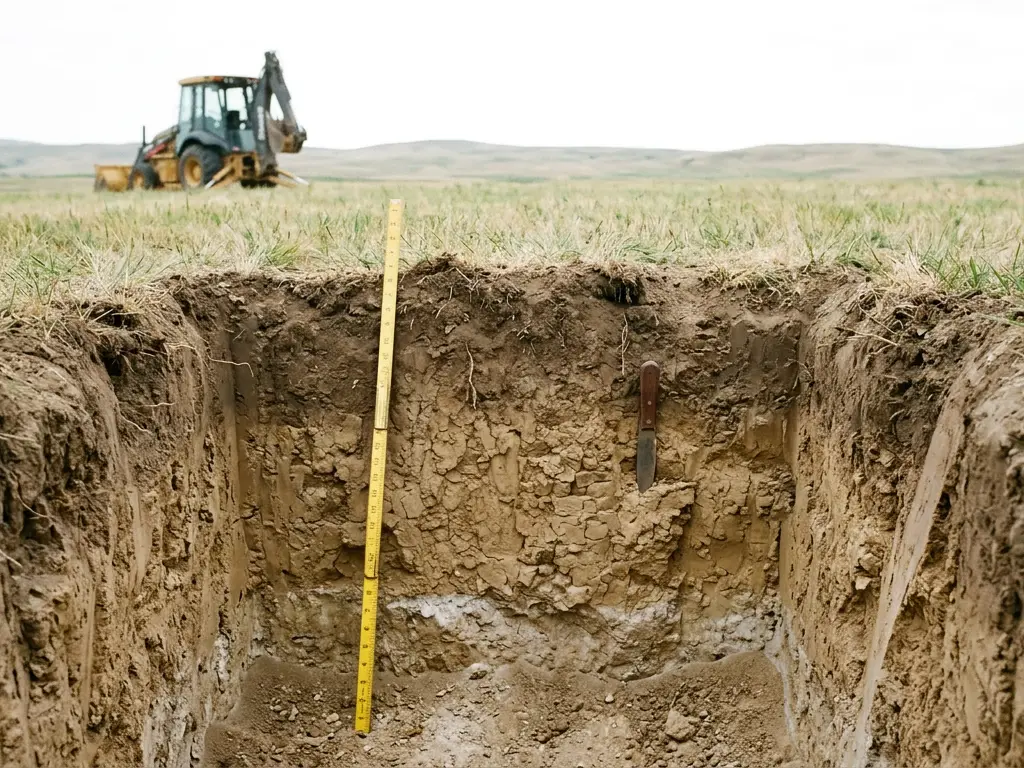
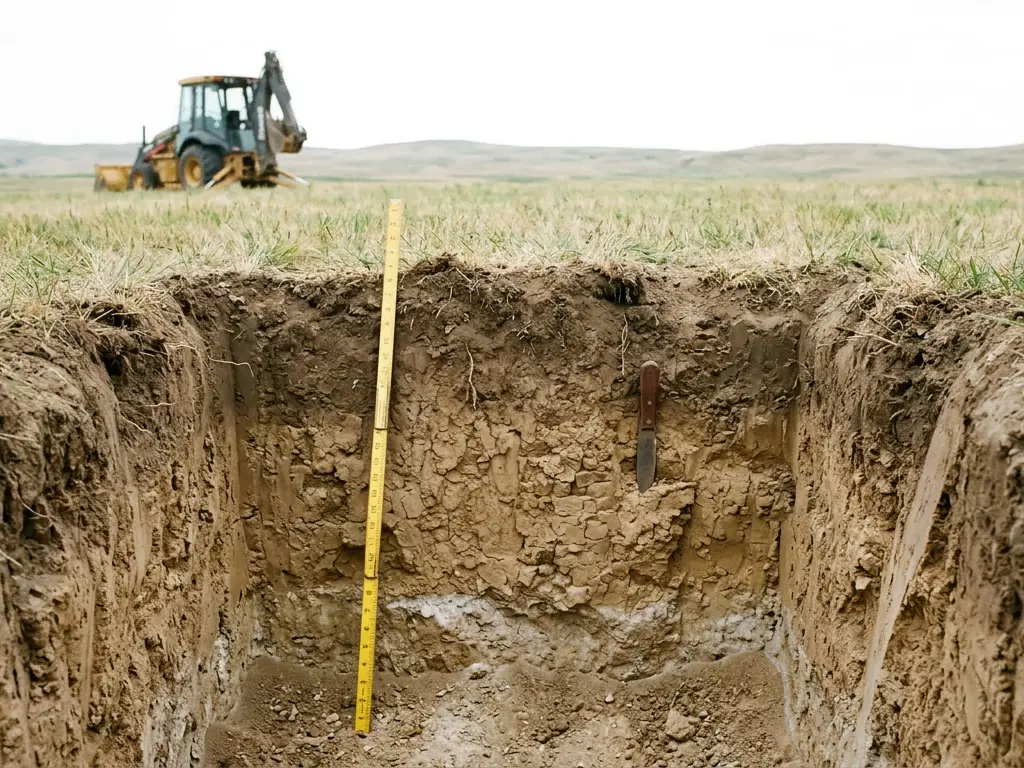
The county requires at least two soil profile test pits, or two test pits and three percolation holes, in the area of the proposed field. The evaluation decides the soil type, and the soil type decides how many square feet of field the house needs. A perc test and soil evaluation is the step that most changes the final cost.
When an engineer has to design it
The county requires a design signed and stamped by a Registered Professional Engineer in four situations:
- The system uses flood dosing or pressure distribution
- The soil is type 0, 3A, 4, 4A or 5 under the county's soil table
- Groundwater or another restrictive layer is within four feet of the ground surface
- The ground slopes more than 30 percent
On the clay loams west of Greeley and the river ground along the Cache la Poudre and South Platte, one of those often applies. An engineered system is also inspected by its design engineer before it is covered, and the engineer sends the county a signed letter approving the installation.
The inspections
Before the permit is issued, the county inspects the site. The owner's name and address must be posted on a sign readable from the road, and the test pits, the proposed and existing system, and any well, cistern or water line must be staked or flagged. A site that is not marked can mean delay and a $100 reinspection fee. Dogs must be shut in. Processing takes about five working days with a complete application.
After installation, the county inspects the work before it is backfilled, usually within three business days of being told it is ready. The installer then files a record drawing showing the system as built. If an old tank is being abandoned, the installer has to provide a pump receipt from a Weld County licensed septic tank cleaner, and the county inspects the abandonment or accepts photos approved in advance.
Not sure what the system needs? Describe what you are seeing and get a straight answer on what it usually takes.
Call (970) 442-7072Setbacks
Weld County's setback table puts a septic tank at least 50 feet from a well, and a leach field at least 100 feet from a well and 50 feet from a lake, watercourse or irrigation ditch. On acreage with a domestic well and a ditch, those distances decide where a field can go.
What Weld County does not require
Weld County has no Transfer of Title or use permit program. In the county's own words, you are not required to have your system inspected when the title transfers. It recommends an inspection, and a pump-out by a licensed cleaner, before a new owner takes over, and most buyers' agents ask for one. A septic inspection covers what that involves.
Larimer County, a few miles west, does require one, which matters in towns that straddle the line like Windsor and Johnstown. Check the parcel's county before assuming either way.
Finding an existing permit
Existing septic permits are on record with the county and can be looked up through the Weld County property portal by parcel. A permit file often includes a drawing of the system, which is the quickest way to find a buried tank. The county also issues a statement of existing for $25.
Questions people ask
How much is a septic permit in Weld County?
In 2026, $1,500 for a new residential system, $1,100 for a repair, $450 for a vault and $250 for a minor repair.
Does Weld County require a perc test?
It requires a site and soils evaluation: at least two soil profile test pits, or two pits and three percolation holes.
How long does a Weld County septic permit take?
About five working days after a complete application, longer if documents are missing or the site is not marked.
Does Weld County require a septic inspection when a house is sold?
No. Weld County has no Transfer of Title program, though it recommends an inspection and a pump-out.
How do I look up a septic permit in Weld County?
Through the county's property portal by parcel, or by contacting the Environmental Health division.
When does Weld County require an engineer for a septic system?
For pressure distribution or flood dosing, soil types 0, 3A, 4, 4A or 5, groundwater within four feet, or slopes over 30 percent.
Talk it through before anyone digs
Say what the house is doing, how old the system is and when the tank was last pumped. You will hear what the job usually involves, what it tends to cost, and whether it needs digging at all.
Call (970) 442-7072