
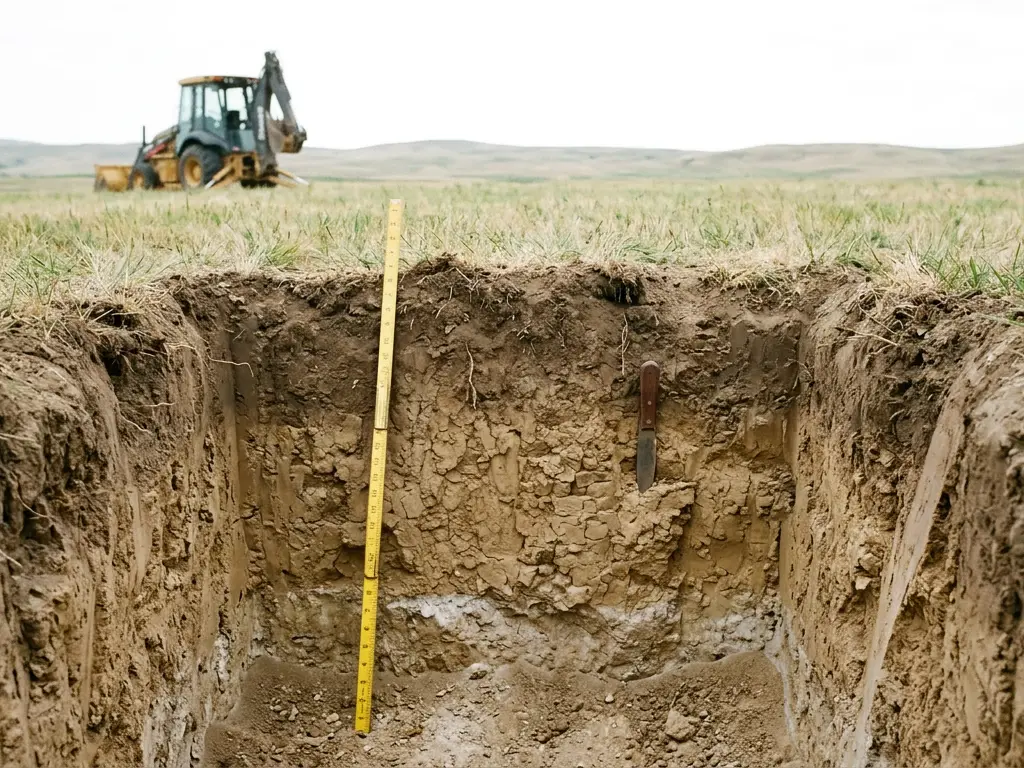
The test pits that decide the system
Greeley Quality Septic Perc Test and Soil Evaluation in Greeley
Before any new system or replacement field, Colorado's counties want to see the soil. This is where that happens.
- Greeley and nine towns within 20 miles
- Written price before any digging
- Licensed, insured local contractors
- Weld and Larimer County rules covered
Greeley Quality Septic arranges site and soils evaluations around Greeley, the test pits and percolation tests every new septic system and every replacement leach field needs before the county will issue a permit. People still call it a perc test, but in Colorado the evaluation is mostly about reading the soil profile in a pit, with percolation tests as a second line of evidence.
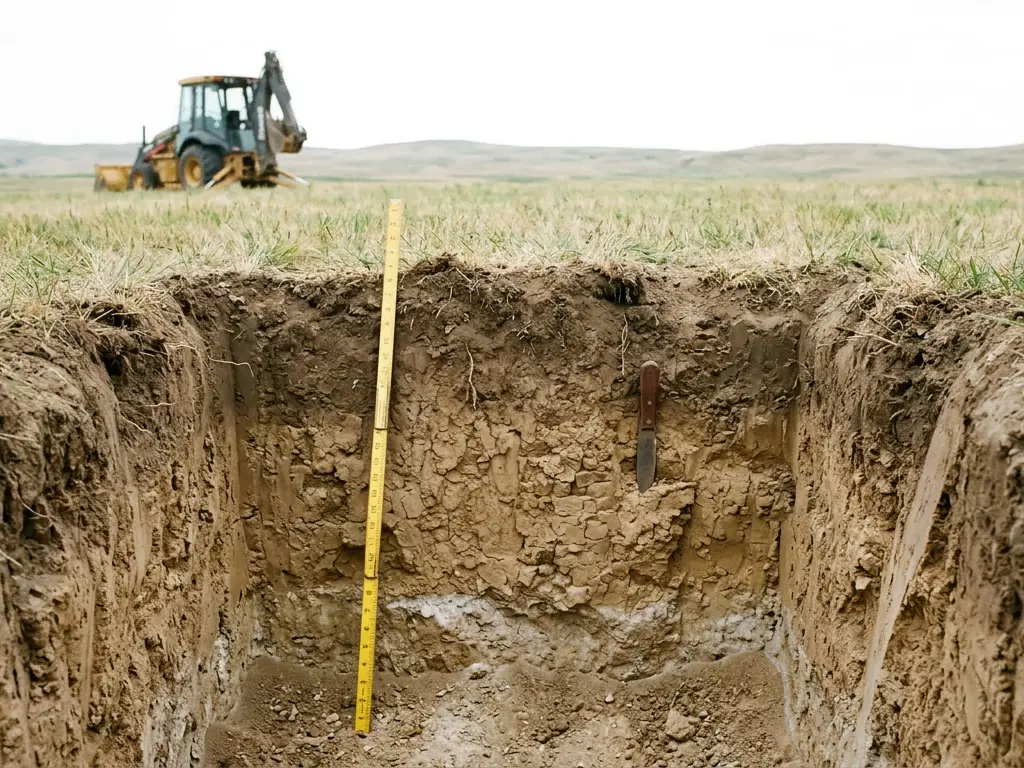
A soils evaluation typically costs $500 to $1,500; buying a lot or ordering a design without one risks a site that needs a $28,000 to $35,000 engineered system nobody budgeted for.
$500 to $1,500 for the soils evaluation and report
A septic site and soils evaluation in this area typically runs $500 to $1,500 for the testing and the written report, the range a Fort Collins septic company publishes for Larimer County work. The engineered design, where the site needs one, is separate at typically $1,500 to $5,000. Larimer County charges a $290 site evaluation fee when it has to inspect the test pits before they are backfilled.
Get a price: (970) 442-7072When you need a soils evaluation
- You are building a new house on a lot with no sewer
- The leach field has failed and has to be replaced
- You are buying land and want to know what system it will need
- A bedroom or a dwelling is being added and the system has to grow
- The county has asked for one with a permit application
What Weld County requires
A site and soils evaluation is required for a new system and for replacing or upgrading a soil treatment area. It has to be performed by, or under the direct supervision of, a professional engineer, a professional geologist, or a qualified technician or soil scientist the county approves.
The minimum is two soil profile test pits, or two soil profile test pits plus three percolation holes, in the area where the field will go. The pits and the proposed field have to be staked or flagged so the county inspector can find them at the site inspection, along with the location of any well.
What happens in the pit
A backhoe digs a pit deep enough to see the soil down to any limiting layer, or four feet below where the bottom of the field would be. The evaluator logs each layer: texture, structure, color, roots, and any sign of seasonal saturation. At least one pit goes in the part of the proposed field expected to be worst.
From that, the soil is assigned a type under Colorado's soil table, and each type has a long-term acceptance rate: how many gallons a day each square foot of field can absorb. That number sets the size of the field. Where percolation tests are also run and the two answers disagree, the design uses the more restrictive one.
Not sure what the system needs? Describe what you are seeing and get a straight answer on what it usually takes.
Call (970) 442-7072What the soil usually says around Greeley
USDA's ratings, sampled across 25 points per town, give a fair preview. North of the Cache la Poudre and around Severance, most points are sandy loams rated "not limited" for a conventional field. Around Johnstown, Berthoud, Loveland and Fort Collins, the Nunn, Weld and similar clay loams mostly rate "very limited" or "somewhat limited" because water moves through them slowly. Close to the rivers, flooding and a shallow saturated zone take over.
Many profiles here also show a pale, chalky calcium carbonate layer in the subsoil, typical of the plains. It is one of the things an evaluator notes because it can change how water moves.
Timing the pits
Groundwater is the thing a test pit most often gets wrong. On irrigated land and along the rivers, the water table can sit feet higher in summer than in late winter. An evaluation done when the ditches are dry can miss a seasonal high that a later season reveals, and Weld County requires an engineered design when groundwater is within four feet of the surface. An experienced evaluator reads the soil colors for signs of past saturation for exactly this reason.
Buying a lot this month
Ask for the soils evaluation as a contingency in the purchase contract. A few hundred dollars of digging tells you whether the septic system will be a routine cost or the most expensive part of the build.
Call (970) 442-7072Questions people ask
How much does a perc test cost near Greeley?
A site and soils evaluation with its report typically runs $500 to $1,500. An engineered design, if needed, is separate.
Does Weld County require a perc test?
It requires a site and soils evaluation: at least two soil profile test pits, or two pits and three percolation holes, for new systems and field replacements.
What are the signs a lot will fail a perc test?
Standing water after irrigation, heavy sticky clay, a hard layer near the surface, or mottled gray subsoil that shows seasonal saturation.
Who can do a septic soils evaluation in Colorado?
A professional engineer or geologist, or a qualified technician or soil scientist working under one or approved by the county.
What does a soils evaluation decide?
The soil type and its acceptance rate, which set the size of the field and whether an engineered system is required.
Often done together
-
New septic installation
For a new house on a lot with no sewer, the septic system is designed before the house, and the soil decides how.
-
Engineered septic systems
Pressure-dosed fields, pump tanks and treatment units, designed and stamped by a professional engineer for the lots where a simple gravity field will not work.
-
Leach field replacement
When a field has stopped taking water, the fix is a new one, sized and designed for the soil on your lot.
Talk it through before anyone digs
Say what the house is doing, how old the system is and when the tank was last pumped. You will hear what the job usually involves, what it tends to cost, and whether it needs digging at all.
Call (970) 442-7072