
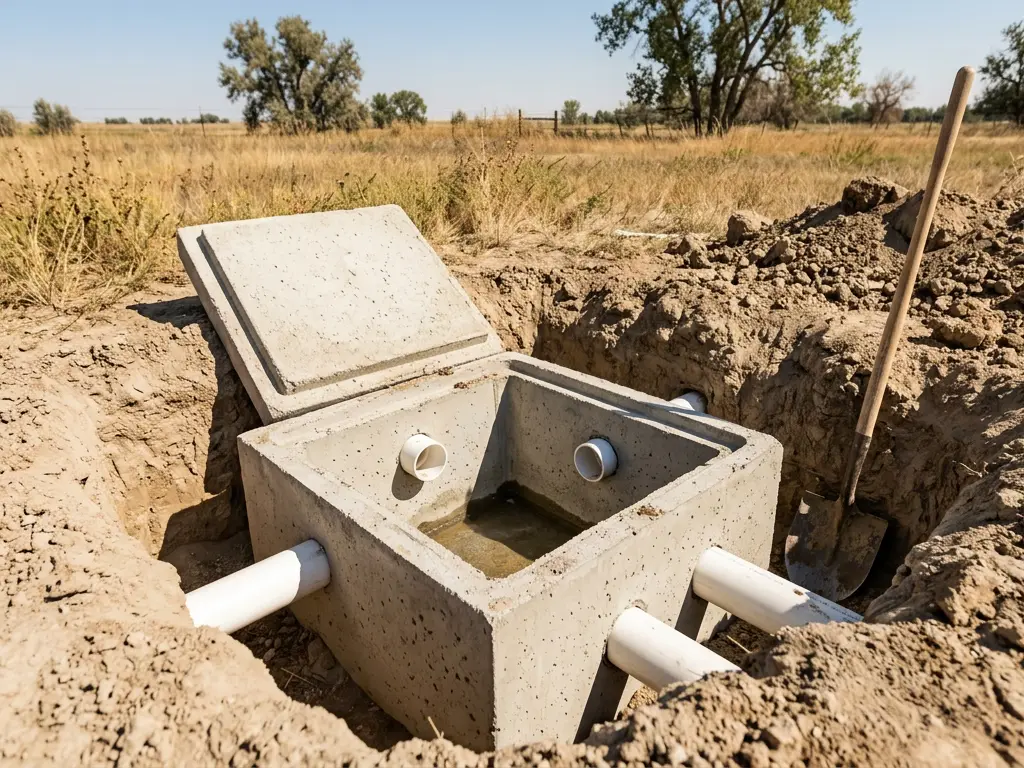
Fixing the part before it costs you the field
Greeley Quality Septic Septic Repair in Greeley
Most septic systems that fail early fail because a small part broke and nobody noticed. Repairs are how you keep a $500 problem from becoming a $25,000 one.
- Greeley and nine towns within 20 miles
- Written price before any digging
- Licensed, insured local contractors
- Weld and Larimer County rules covered
Greeley Quality Septic arranges septic repairs around Greeley for the parts that wear out between replacements: baffles and tees, the line from the house, lids, effluent filters, distribution boxes, pumps and alarms. A repair is almost always found during a pump-out or an inspection, and the earlier it is fixed, the less of the system it takes with it.
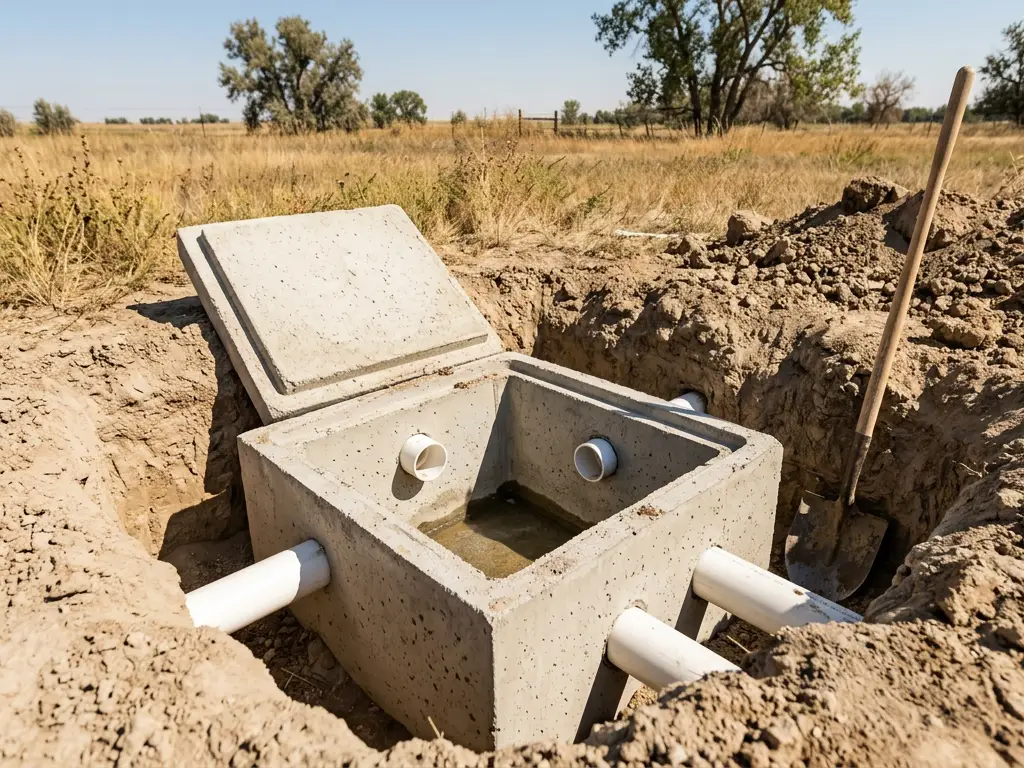
A missing outlet baffle is a $300 to $800 repair; left alone, it lets floating scum pour straight into the leach field, and that ends in a $22,000 to $29,000 field replacement with a county permit attached.
$300 to $800 for minor repairs
Minor septic repairs around Greeley, such as a baffle, an effluent filter service or a lid, typically run $300 to $800, which is the range a Fort Collins septic repair company publishes for this work. A distribution box replacement runs more, and repair of part of a leach field more again. In Weld County, a minor repair such as a sewer pipe or a tank lid replacement also needs a $250 minor repair permit; in Larimer County a minor repair permit is $750 in 2026.
Get a price: (970) 442-7072Signs a part has failed
- A sewage smell in the yard near the tank, but the drains still work
- One side of the house draining slowly while the rest is fine
- Water standing over one part of the field and not the rest
- An alarm that sounds and then stops, or never stops
- A lid that rocks, has cracked, or has settled below the grass
The repairs that come up most
Baffles and tees
The inlet and outlet baffles keep the floating scum and settled sludge inside the tank. Older concrete baffles corrode in the gases inside a tank and drop off, and the outlet baffle is the one that matters most: without it, solids go straight to the field. A plastic sanitary tee or a new baffle is a routine fix once the tank is pumped.
The line from the house
Roots, a sag, or a joint pulled apart by frost or settling can stop the building sewer between the house and the tank. A camera down the line shows which. Weld County treats sewer pipe replacement as a minor repair with its own permit.
Effluent filters
Many newer tanks have a filter on the outlet that catches small solids before they reach the field. It needs rinsing at every pump-out, and a clogged one backs the house up even though the field is fine.
Lids and risers
A cracked or undersized lid is a safety problem as well as a leak, and a lid buried deep in clay is the reason pumping costs more than it should. A riser to grade fixes both.
When a repair is not enough
A repair fixes a part. It does not fix a leach field that has stopped taking water. If the pumper sees water flowing back into an empty tank from the field, or the ground over the field stays wet in a dry spell, the problem is the soil treatment area itself, and the honest answer may be a leach field repair or a replacement.
The dividing line in Weld County is the permit. Replacing or upgrading any part of the soil treatment area is a repair permit at $1,100, with a site and soils evaluation and a design, not a minor repair.
Not sure what the system needs? Describe what you are seeing and get a straight answer on what it usually takes.
Call (970) 442-7072Repairs on Greeley's two kinds of ground
On the sandy loam terraces north of the Cache la Poudre and around Severance, fields take water easily, and most failures start in the tank: a baffle, a filter, a pump. On the clay loams west toward Windsor and Berthoud, the field has less margin, so a small part that lets solids through does damage faster. Either way, the repair is cheaper than what it protects.
What happens on a repair call
- The tank is located and usually pumped, because most parts cannot be seen or reached under a full tank.
- The failed part is identified and photographed, and you hear what it is and what the fix typically costs.
- The county permit, where one is needed, is pulled before the work, and the repair is done to the county's standard.
- You get a written price before any of it starts.
Alarm going off right now
Cut water use in the house. An alarm on a pump tank means the water level is too high, often because the pump or a float has failed. The tank has some reserve, but not much. Call and describe it.
Call (970) 442-7072Questions people ask
How much does septic repair cost in Greeley?
Minor repairs such as a baffle, a filter or a lid typically run $300 to $800. Distribution boxes and partial field repairs cost more.
Do I need a permit to repair a septic system in Weld County?
A minor repair such as a sewer pipe or tank lid needs a $250 minor repair permit. Any work on the leach field needs a $1,100 repair permit.
What are the signs my septic system needs repair?
A smell near the tank, one side of the house draining slowly, wet ground over part of the field, or an alarm.
Can a broken baffle ruin a leach field?
Yes. The outlet baffle keeps scum in the tank. Without it, solids reach the field and clog the soil.
Is it cheaper to repair or replace a septic system?
Repair whenever the field still takes water. Replacement is for a field that has stopped working, and it costs tens of thousands of dollars.
Often done together
-
Distribution box replacement
A distribution box splits the flow from the tank between the leach lines. When it tilts, cracks or clogs, one line takes everything and fails early.
-
Septic alarm and pump repair
Engineered and lift systems rely on a pump, and the alarm is how the system tells you the pump has stopped keeping up.
-
Leach field repair
When one leach line fails, or a field starts to struggle, there is often still something worth saving.
Talk it through before anyone digs
Say what the house is doing, how old the system is and when the tank was last pumped. You will hear what the job usually involves, what it tends to cost, and whether it needs digging at all.
Call (970) 442-7072